Céu Executivo Notícias
Southeast breaks passenger record in February and increases pressure for operational efficiency at hubs
With 4.9 million boardings and an increase of 6.8% in the year, the movement reinforces heated demand at key airports and increases the planning burden for corporate operations.
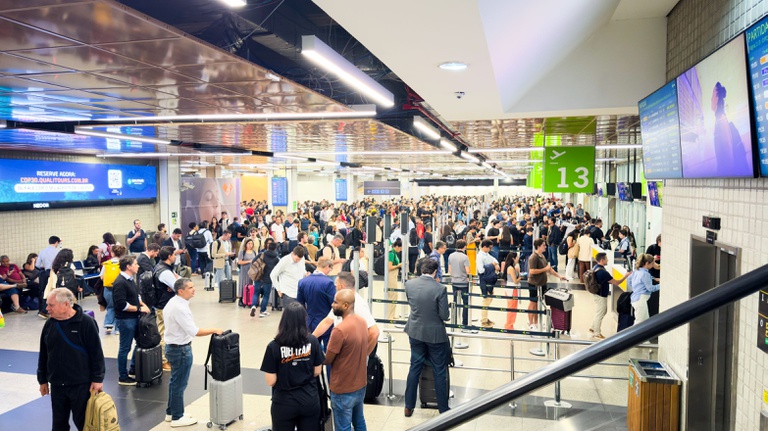
Data released by the Ministry of Ports and Airports on March 30, 2026 show that the Southeast registered 4,902,827 passengers embarked in February, the best mark for the month since the beginning of the ANAC historical series, in 2000. The volume exceeded the result of February 2025 by 6.8%. The number confirms a robust recovery in demand and replaces airport capacity in the center of the operational efficiency discussion.
The breakdown by terminals helps to understand the size of the pressure: Guarulhos appeared with 3.6 million passengers in the period; Congonhas, 1.8 million; Galeão, 1.6 million; and Confins, 907 thousand. The Congonhas-Santos Dumont air bridge, with 299,963 passengers, remained a very high intensity corridor. In timeliness-dependent operations, this level of traffic changes the window, ground, and connection planning logic.
Why this data matters for executive operations
Even when the flight is corporate or chartered, the shared infrastructure of large hubs influences taxi times, apron availability, fueling efficiency and slot predictability. In high demand environments, small delays lead to crew costs, loss of schedule productivity and risk of unnecessary repositioning.
Therefore, the impact is not just on the total volume of regular passengers. It appears in the systemic congestion of the most strategic airports for business in the country. Those who operate with an intense routine between São Paulo, Rio and Minas already feel that basic decisions, schedules and ground support have become management issues, not improvisation.
What to watch from now on
The trend for the coming quarters is for continued firm demand, with selective growth in routes and terminals with greater corporate capillarity. In this scenario, the competitive advantage tends to go to those who organize operations in advance: well-tied support contracts, risk reading per airport and alternative route and apron plans for critical periods.
In summary, February's record is not just a good number for sectoral statistics. It signals that the cost of inefficiency has risen. In 2026, the difference between fluid operation and vulnerable operation increasingly involves planning discipline and quality of execution on the ground.
Aeronaves citadas
Modelos mencionados nesta matéria para aprofundar comparações de cabine, autonomia e posicionamento no mercado.